

Confidence in learning is not something children are born with. It is built, layer by layer, through experiences of genuine discovery. When a child figures something out on their own and feels the satisfaction of that moment, their belief in their own ability grows. That is why strong pre k math experiences are so powerful. They do not just teach math. They teach children that they are capable of learning anything.
The years between ages three and eight are widely recognized as the most critical window for developing cognitive habits. What children learn during this period, and how they learn it, shapes their relationship with challenge and learning for years to come.
What Pre K Math Should Actually Look Like
How Pre K Math Goes Beyond Counting and Shapes
Many parents associate pre k math with basic counting, color recognition, and simple shape naming. These are valuable starting points. But genuine pre k math goes considerably deeper. It involves building number sense, which is the intuitive understanding of how quantities relate to each other. It involves spatial reasoning, which is the ability to visualize and manipulate shapes and spaces mentally. And it involves logical thinking, which is the capacity to notice patterns and draw conclusions from observations.
SunStart’s curriculum addresses all of these dimensions from the very beginning of Level A. Children aged three to four are guided through activities that develop these foundational skills through exploration, story, and hands-on interaction rather than memorization or repetition.
Why Elementary Math Outcomes Depend on Pre K Foundations
The connection between pre k experiences and elementary math performance is not a matter of opinion. Children who develop strong number sense and spatial reasoning before kindergarten consistently outperform their peers in elementary grade math assessments. More importantly, they approach those assessments with a different attitude: one of curiosity and confidence rather than anxiety and avoidance.
Elementary math introduces formal operations, symbolic notation, and increasingly abstract concepts. Children who have already built a concrete, tactile understanding of what numbers mean and how shapes behave find these abstractions far more accessible.
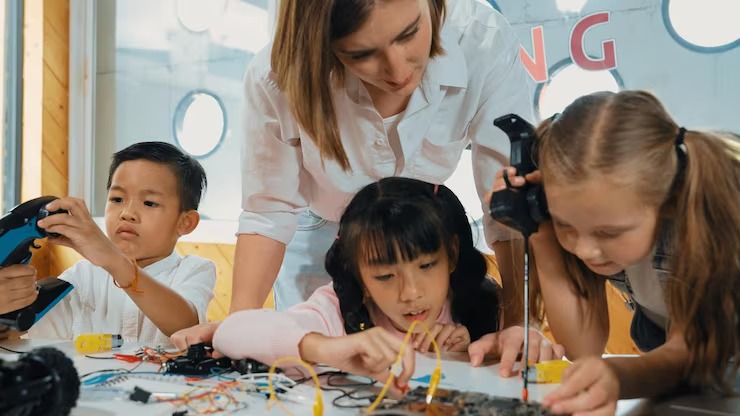
Three Principles That Define Effective Pre K Math
How Pre K Math Should Be Structured for Maximum Impact
SunStart’s approach is built on three core principles that guide every activity and every interaction within the program.
First, learning must begin with curiosity. Children are naturally drawn to discovering patterns and solving puzzles. Programs that lean into this natural drive produce learners who are intrinsically motivated rather than compliance-driven.
Second, exploration must precede explanation. When children are given the opportunity to discover a concept before being told what it is, their understanding is far deeper. They own the idea in a way that externally delivered instruction never achieves.
Third, expression must follow exploration. When children put into words what they noticed and how they figured it out, they consolidate their learning at a much deeper level. SunStart builds guided discussion into every learning cycle for exactly this reason.
Practical Pre K Math Activities That Build Real Understanding
- Sorting household objects by size, color, shape, or weight
- Building simple structures and describing their shapes
- Counting objects in groups and comparing which group is larger
- Arranging items in patterns and predicting what comes next
- Measuring everyday things with simple tools or non-standard units
These activities, when done with curiosity and guided questioning, build exactly the cognitive foundations that structured pre k math programs develop more systematically.
The Bridge Between Pre K and Elementary Learning
How Pre K Math Thinking Transforms in Elementary School
What begins as tactile exploration in pre k becomes formal reasoning in elementary school. The child who spent ages three to five building towers and sorting shapes is the same child who visualizes geometry problems effortlessly at age seven. The child who compared quantities with physical objects is the same child who understands what subtraction means at a conceptual level.
SunStart’s five-level curriculum is designed to honor this natural progression. Each level extends and deepens what the previous one established, creating a genuinely continuous learning journey rather than a series of disconnected experiences.
Conclusion
Pre k math done well is one of the most transformative things a child can experience in their early years. It builds not just mathematical skill but genuine learning confidence, the habit of thinking carefully, and the resilience to keep trying through difficulty. SunStart’s approach brings all of these outcomes together in a system that is joyful, age appropriate, and deeply effective.
Frequently Asked Questions
Q1: How do I know if my pre k child is ready for a structured math program? If your child shows curiosity about numbers, enjoys sorting and building, and likes asking why, they are ready. SunStart’s Level A is designed specifically for children as young as three with no prior formal experience.
Q2: How much time per day should pre k math take? Short, focused sessions of fifteen to twenty minutes are ideal for this age group. Consistency matters more than duration. SunStart’s activities are designed to fit naturally into a family’s daily rhythm.
Q3: Will pre k math programs make learning feel like pressure for young children? Not when they are well designed. SunStart uses story, play, and discovery to make every activity feel like an adventure rather than instruction. Children who enjoy the process learn far more effectively.